Technique · Issue No. 1
·
Subscriber Story · Free Preview
Beauty Is Not
a Four Letter Word
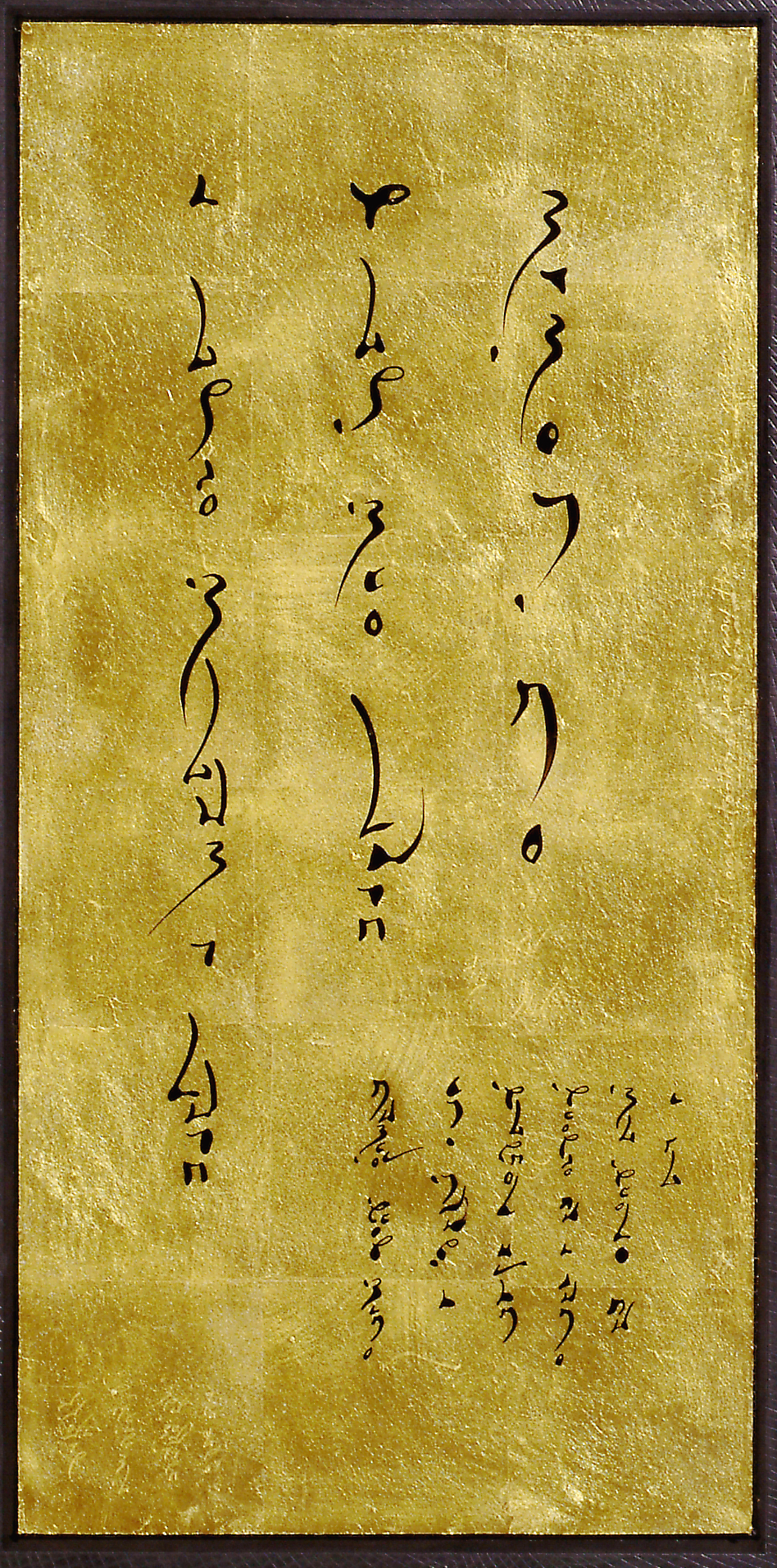
Elian script began as a private code in a notebook. Forty years later, its creator calls its fluidity "line jazz" — and it may be the closest a Latin alphabet has come to the freedom of Asian calligraphy.
By C.C. Elian · 9 min read
Elian script is a synthesis of the two major writing systems: the Latin alphabet and the lines and dashes of Asian logograms — Chinese, Japanese, Korean. As such, the same calligraphic expression found in Asian calligraphy is possible while writing in English, French, Italian, Spanish, German, or any Latin alphabet based system.
This is possible because logograms are abstract drawings representing things and ideas with lines and dashes. Unlike the phonetic forms of alphabetical symbols, logograms have zero sound encoded in them.
However, with Elian script as a bridge, Western and Eastern calligraphers meet on common ground: a Western calligrapher can put lines to their sounds, and an Eastern one can put sounds to their lines.
It's important to know that the goal is not to imitate Asian calligraphies and logograms. Rather, they're discussed as a parallel to Elian script because they illustrate what's aesthetically possible when one writes with pure lines and dashes. And since Asian calligraphies have been around for almost 2,000 years, there's a great deal we can learn from the techniques and philosophy that have been handed down.
Because its structure is based upon a 9-square, tic-tac-toe grid, and because the hardest part is knowing the Latin alphabet, an 8-year-old can learn this system — but it takes a genuine calligrapher to practice bringing out its aesthetic potential. In the same way that I see many people develop Elian script in terms of graphic design, I'm certain that dedicated calligraphers can take this script well beyond what I have done.
Calligraphic styles are similar to musical instruments — each style, or instrument, offers different tonalities that come specifically from their structure and materials. There's no getting around the fact that according to the style, one has a greater or lesser freedom of composition and range of motion. Like Asian calligraphy, Elian script offers a maximum of freedom of motion and compositional choice.
You might ask: why not just do freeform lines to get the same aesthetic and existential process as with Asian calligraphy, rather than needing words? The answer is that lines disconnected from forming words cannot contain the psycho-semantic tension of lines that do represent a word-specific beginning and end. With random lines, a psychological relationship is missing between the calligrapher and the marks on the paper.
This psycho-emotional tension is why the aesthetic appreciation of Asian calligraphy doesn't depend on comprehension of the words written. It is the tension within the intended meaning of the calligraphy that gives the composition of lines their personality, revealing both skill and the calligrapher's character.
Step by step: how to write in Elian script
Elian script is based upon the 9-square grid, and its sections codify the 26-letter Latin alphabet. If you isolate the sections, you see that each has a unique configuration from the others. Once we place the letters of the alphabet into the grid, this fact becomes the scaffolding for the script.